
The Value of Proximity: Where Entrepreneurs, Capital and Networks Meet
Updated: Aug 17
Reflections from Canaccord Genuity’s 46th Annual Growth Conference by Liz Priestman.
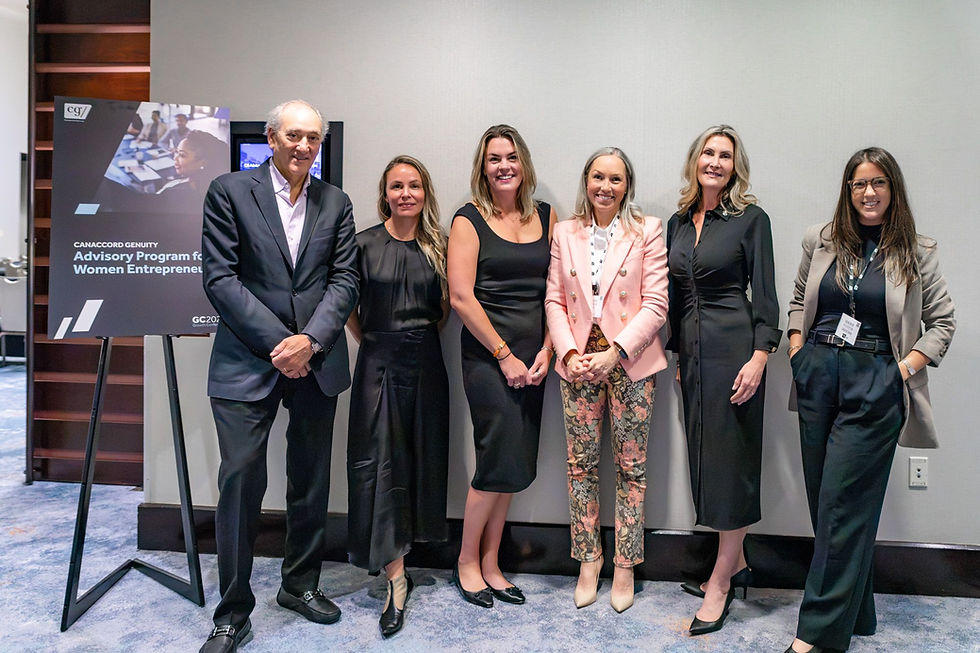
Pictured above: David Kassie, Kyla Fox, Julia Becker, Dr. Aisling Lanigan, Liz Priestman, Genevieve Eccleston
Last week, I had the pleasure of joining Canaccord Genuity’s 46th Annual Growth Conference in Boston, where I chaired presentations from this year’s participants in the Canaccord Genuity Advisory Program for Women Entrepreneurs.
More than 450 companies presented over three days, alongside thousands of one-on-one meetings between entrepreneurs, investors and advisors. A number of family office guests were also in attendance, giving me the opportunity to spend time with familiar faces outside the smaller, private forums I typically host through Crest.
The scale was very different, yet it reinforced something I have come to appreciate over many years of working with family offices and entrepreneurs. Access to opportunities is important. Access to the people behind them can be considerably more valuable.
Understanding the People Behind the Opportunity
Family offices occupy a distinctive position within the private capital ecosystem. Their flexibility often allows them to discover opportunities through a wide range of channels, including trusted advisors, other families, entrepreneurs and relationships developed over many years.
Meeting an entrepreneur in person adds context which is difficult to capture in a presentation deck. How well do they understand the problem they are solving? How do they articulate the opportunity? How do they respond when challenged? What motivates them? Who have they surrounded themselves with?
These impressions are not a substitute for due diligence, although they can provide an important dimension to it. This was particularly evident in the three businesses presented through Canaccord Genuity’s Advisory Program for Women Entrepreneurs.
What struck me about all three was how deeply their solutions begin with the lived experience of the people they serve. Each is operating in healthcare and addressing problems people have too often been expected simply to live with.
Julia Becker leads capital markets for Livia, whose clinically proven, FDA-cleared technology offers women a drug-free alternative for managing menstrual discomfort. Kyla Fox founded The Kyla Fox Centre, which approaches eating-disorder recovery through a model of care supporting individuals, parents and families. Dr. Aisling Lanigan is building Flourish around a more connected model of women’s healthcare extending from fertility through menopause.
The businesses and approaches are different, but each begins with an unusually close understanding of the person experiencing the problem. Technology can make a solution possible and innovation can make it scalable. Understanding people can reveal an opportunity others may not have recognised.
For family offices assessing emerging companies, this distinction is worth considering. Some of the most compelling businesses are not technologies searching for applications. They begin with entrepreneurs who understand a market or problem unusually well and develop a differentiated solution around it.
Relationships Provide Context
One of the highlights for me in Boston was seeing Laura Caba, Co-founder and President of Vesica Health, join the conference in person. Laura participated in last year’s program and returned following Vesica Health’s acquisition by Photocure in a transaction valued at more than US$30 million. Another member of last year’s cohort, Ally Mamalider, Founder and CEO of Organic Traditions, recently completed a $10.5 million Series A financing to support her company’s continued growth. It is wonderful to see how much had changed for both entrepreneurs in only a year.
These are significant outcomes, but their relevance extends beyond the transactions themselves. They demonstrate how quickly an emerging company can evolve and why maintaining relationships with entrepreneurs over time can provide valuable perspective on their progress.
This is particularly relevant for family offices, where investment horizons and decision-making processes can differ considerably from those of institutional capital. An opportunity which is too early today may become relevant later. A founder met through one company may eventually build another. An introduction may lead to a relationship with no immediate transaction attached to it. The value of these relationships is not always apparent at the outset. Often, it reveals itself over time.
Trusted Networks in Private Markets
Much of what we do at Crest reflects a belief I have developed over many years: smaller, carefully curated environments create a different quality of conversation. Boston was a much larger setting, although the underlying principle remained remarkably similar.
Strong private-market networks are built over time through repeated interactions, trusted introductions and a willingness to share perspectives without requiring every conversation to produce an immediate outcome.
For family offices, these networks can also provide an important filter. The private markets contain no shortage of opportunities or information. The challenge is increasingly deciding where to spend time and which people, companies and themes warrant closer attention.
Trusted relationships can help provide this context. They allow families to encounter ideas through people whose judgement they know, meet entrepreneurs at different stages of development and learn from the perspectives of other families, investors and specialists.
Canaccord Genuity’s Advisory Program for Women Entrepreneurs offers an interesting example of this principle in practice. Founded six years ago by Chairman Emeritus, David Kassie, and now led by Genevieve Eccleston, the program brings entrepreneurs together with experienced advisors and a growing professional network.
The Value of Staying Close
As I left Boston, I found myself reflecting on the sheer scale of what we had experienced over three days: more than 450 companies, thousands of meetings and an extraordinary concentration of entrepreneurs, ideas and capital in one place.
For family offices, perhaps the value of being in a room like this is not simply access to more opportunities. It is the chance to meet the people behind them, ask questions, form an impression and, in some cases, begin a relationship worth following.
With so much activity across the growth economy, the challenge is rarely finding opportunities. It is knowing which ones are worth staying close to. Having seen how previous participants in the Advisory Program have grown and evolved, I will certainly be following this year's entrepreneurs with interest and look forward to seeing where their journeys take them.


